Telehandler attachments for rent
Rent telehandler attachments: pallet forks, buckets, work baskets, winches and more. Optimise your work processes. Request a quote.
Telehandler attachments - the quick coupler system as an investment multiplier
A telehandler without attachments is a lifting machine. With the right range of attachments, it becomes a crane, aerial work platform, excavator, loader and cleaning machine - on the same chassis, on the same working day. The hydraulic quick coupler is not an accessory but system architecture: it defines how many specialised machines a single telehandler can replace in the fleet.
The quick coupler system: how it works and what it means legally
Technical operating principle
The hydraulic quick coupler sits at the boom head. Two hydraulic cylinders tension a locking profile that engages in the standardised mounting of every compatible attachment. Attachment changes without leaving the cab, without tools, in under 60 seconds. Hydraulic connections couple automatically when locking; electrical plug connections for weighing or controls do the same.
CE conformity of the combination: the overlooked legal point
This is where the most common compliance error in telehandler operation lies: it is not only the carrier machine and not only the attachment that must be CE-compliant - but the combination of both. The Machinery Directive 2006/42/EC treats the carrier machine and the attachment as one complete machine as soon as they work together.
Consequences for the buyer:
-
Attachments from other manufacturers without manufacturer approval for the specific carrier machine can void the CE conformity of the entire system
-
The periodic inspection by an external technical inspection body (EDTC/SECT) covers all attachments used; attachments that are not listed are rejected
-
In the event of damage, the operator is liable if non-approved combinations were used
Luibl supplies only attachments approved by the manufacturer for the respective carrier machines and with complete CE documentation for the combination.
The attachment range in detail
Pallet fork - basic equipment
Standard version with fixed fork width for Euro pallets (800 x 1,200 mm). Decisive when buying: the residual capacity after deducting the attachment's own weight. A 4 t fork itself weighs 180 - 320 kg; this load is deducted from the carrier machine's load chart.
Variants:
Fork positioner (hydraulic): fork width infinitely adjustable from the cab; essential for changing pallet formats and industrial applications
Wide fork: for oversized loads such as formwork elements, steel beams, pipe bundles
Side shift: horizontal movement of the load without moving the machine; precise positioning in warehouses and during assembly work
Load hook and winch - the crane function
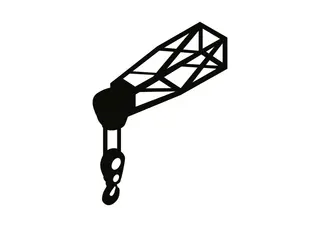
With a load hook and a freely suspended load, the telehandler becomes lifting equipment within the meaning of the Code on Well-being at Work, Book IV (work equipment). A winch additionally allows controlled lowering and lifting from pits or shafts.
Technical requirements for operation:
Load handling with lifting accessories (chains, round slings) in line with applicable Belgian safety rules and NBN EN standards
A freely suspended load must not be travelled with - the machine must be stationary
Winch attachments require their own periodic inspection by an external technical inspection body (EDTC/SECT) in addition to the telehandler inspection
Work basket - aerial platform function with 360 degree slewing
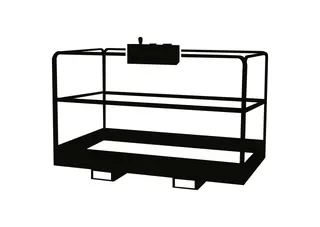
The work basket with CE marking according to EN 280 turns the telehandler into an aerial work platform. Load capacity typically 200 - 350 kg (1-2 persons + tools). On the roto telehandler, the basket rotates with the superstructure - full 360 degree positioning without repositioning the machine.
Critical legal point: for operation with a personnel basket, the requirements of EN 280 apply in full - including periodic inspection as an aerial work platform, operator training according to ISO 18878 and the work instruction for lifting persons. The operator must explicitly include this in the risk analysis under the Code on Well-being at Work, Book IV (work equipment).
Bucket - earthmoving and material handling
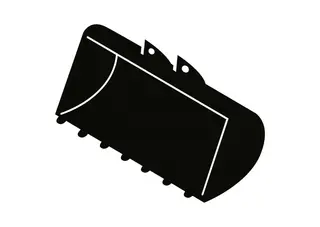
Tipping bucket (standard): for sand, gravel, soil, rubble; volume 0.3 - 1.2 m3 depending on the model
High-tip bucket: empties over obstacles and into high containers; tipping height up to 3.5 m above ground
Grab bucket: for lumpy material such as stones, tree stumps, demolition waste; hydraulically closing
Bucket with integrated weighing system: for recycling, landfills and bulk material intake with billing accuracy
Concrete skip and mortar container
For concreting on hard-to-reach slab areas and in shaft structures. Capacity 0.3 - 1.5 m3. Discharge via slide gate, controlled from the cab or by pull cable. An alternative to the stationary crane for small quantities and frequent position changes.
Clamp fork and pipe grab
For cylindrical loads: concrete pipes, steel pipes, tree trunks, coils. Hydraulically closing clamp jaws; the load is held in the clamp without lifting accessories. Advantage over the load hook: no slinger needed, faster handling, more precise positioning.
Sweeper and snow clearing
Sweeper attachments with hydraulically driven brush sets for site access roads, company yards and open areas. Working width 1.5 - 2.5 m. Snow plough blade as the counterpart for winter operation.
Residual value: why the attachment set influences the resale price
Telehandlers with a complete, manufacturer-compliant set of attachments achieve 15 - 25 % higher prices on the used market than individual machines without accessories. The reason: the buyer takes over a ready-to-use system with documented CE conformity - and does not need to buy additional attachments or check compatibility.
For investment planning, this means: when sold, attachments increase the residual value of the overall package disproportionately. Renting instead of buying protects liquidity.
Normative requirements
-
Machinery Directive 2006/42/EC - CE conformity for the carrier machine and attachment combination; manufacturer approval required
-
EN 1459-1:2017 - the load chart must show the attachment weight as a deduction
-
Code on Well-being at Work, Book IV - the periodic inspection by an external technical inspection body (EDTC/SECT) covers all attachments used
-
Periodic inspection by an external technical inspection body (EDTC/SECT) - additional inspection for load hook and winch operation
-
EN 280:2013+A1:2015 - applies in full for personnel basket operation
Scope of delivery and advice
Luibl supplies attachments only with:
-
Manufacturer approval for the specific carrier machine (in writing)
-
CE declaration of conformity for the combination
-
Operating manual in German
-
Entry in the inspection register of the carrier machine
Advice on the optimum attachment configuration based on the application profile, the hydraulic data of the carrier machine and your budget. Packages of carrier machine + attachments can be arranged on request as overall financing.
