Roof work with a mast lift - planning, safety, procedures
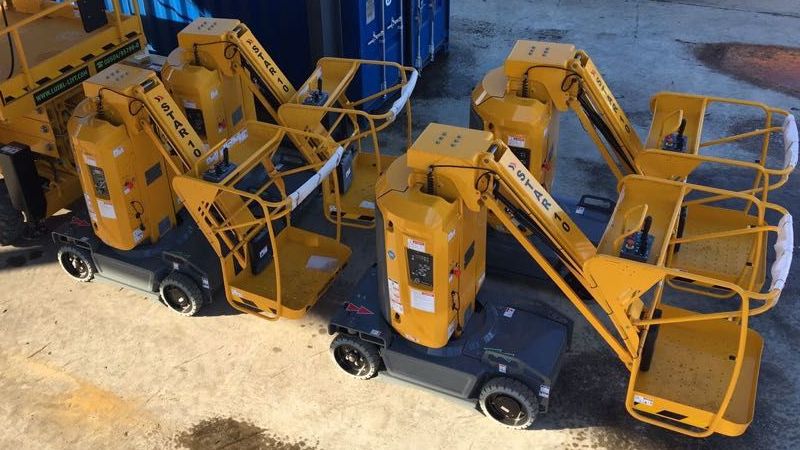
Anyone planning roof work usually thinks straight away of scaffolding or a large articulating boom lift. Many are surprised that the compact mast lift can also be a serious option. Yet on flat industrial roofs, hall roofs or rooftop structures on paved ground in particular, the mast lift offers real advantages: it is quickly ready for use, fits through gates and entrances and can be manoeuvred in tight spaces. What you need to consider when planning, which conditions must be met and when other machines are the better choice - this article shows you.
When is a mast lift the right choice for roof work?
Renting a mast lift for roof work pays off above all when three conditions come together:
- Low to medium-height building
The mast lifts in the Luibl rental fleet reach working heights of up to 12.65 metres. That covers the flat roofs of warehouses, production buildings, garages or commercial properties - in other words, anything with an eaves height of up to around 10 to 11 metres.
- Firm, level ground
Mast lifts are designed for level ground. Asphalted or concrete access roads and yards next to the building are ideal. If the ground is uneven, waterlogged or not load-bearing, articulating boom lifts or spider lifts are the right alternative.
- Limited space
Especially on business premises, where storage areas, loading docks and traffic routes sit close together, the mast lift plays to its strengths. Its small footprint and minimal turning radius let you position it exactly where other machines have no room.
Typical applications are: maintenance of roof penetrations, repair of gutters, installation of ventilation systems or solar panels on flat roofs, and inspection of skylights and continuous rooflights.
Technical requirements: what the mast lift has to deliver
Not every mast lift is suitable for every roof job. The decisive parameters are working height, outreach and load capacity. Luibl has the following models available:
| Model | Working height | Outreach | Special feature |
|---|---|---|---|
| MB-100 (Haulotte Star 10) | 10.00 m | 3.00 m | Minimal footprint, agile indoors |
| MB-100 (Manitou VJR 100) | 10.00 m | 3.00 m | Robust base, compact dimensions |
| MB-126 (JLG Toucan 12E Plus) | 12.65 m | 6.05 m | Basket jib for up-and-over reach |
All models have an electric drive and non-marking tyres. The load capacity is 200 kg - enough for one person plus standard tools and small materials.
Important for outdoor use: Most mast lifts are designed primarily for indoor use. For outdoor use on firm ground, the operating conditions must always be checked on site. From wind force 5 (approx. 8 m/s), work should be stopped.
Safety on site: what you need to clarify before use
Safety in roof work does not start when the machine is switched on, but with the preparation. The following points must be clarified before using a mast lift for roof work:
Ground check
Have the load-bearing capacity of the ground checked by a responsible person, especially for older industrial paving or areas near cellars and drainage shafts. If in doubt, use ground protection mats.
Wind conditions
When extended, mast lifts are sensitive to crosswinds. Check the weather forecast and set a wind limit above which work is stopped.
Fall protection on the roof
The mast lift takes your staff to the roof edge - what happens after that is the responsibility of the employer. On the roof itself, additional protective measures (fall arrest systems, safety harness) are required if work is not carried out from the platform.
Operator authorisation
Operating a mast lift requires the operator qualification in line with applicable Belgian safety rules and NBN EN standards, ideally supplemented by an IPAF operator card. Luibl provides the operator briefing on handover - just mention it in your enquiry.
Cordoning off the work area
Define a safety zone around the machine and secure it against unauthorised access. Tools and materials can fall - especially when working on the roof surface itself.
Step by step: how a roof job with the mast lift works
A structured process reduces downtime and increases safety at work. The following sequence has proven itself in practice:
-
Planning and machine selection - measure the eaves height, check the ground, agree on the right model with Luibl
-
Delivery and set-up - Luibl delivers the mast lift by low-loader to your site; if required, a technician comes on site for the briefing
-
Operator briefing - at least one responsible person must have been briefed on operating the specific model
-
Set up the safety zone - put up barriers, mark the danger zone
-
Position the machine - perpendicular to the roof edge, at a distance that lets the basket safely reach the eaves height
-
Carry out the work - keep a constant eye on the wind, never overload the basket
-
Return and off-hire - clean the machine and have it ready for collection
Case study: flat roof maintenance at a logistics centre in Lower Bavaria
A logistics company from the Landshut area was facing the annual maintenance of its roof: checking the bitumen membranes, cleaning the gravel stops, replacing two ventilation flaps. The building has an eaves height of 9.20 metres, and the yard is fully asphalted.
A local scaffolding quote would have meant three days of erection and considerable extra costs. Instead, an MB-100 (Haulotte Star 10) was rented through Luibl for four working days. Delivery took place the evening before, and the first working day began with a short briefing by the Luibl driver.
Result: all roof work was completed in two and a half days. The mast lift could be moved along the entire length of the building without any problems and without interrupting the ongoing truck traffic in the yard. Total costs were well below the scaffolding alternative - and there was no effort for erection and dismantling.
Frequently asked questions
Can I really use a mast lift for work on the roof?
Yes - if you access the roof from the platform or work at the roof edge. The mast lift stays on the ground while the basket is positioned at the height of the roof edge.
From what building height is a mast lift no longer sufficient?
The maximum working height of our mast lifts is 12.65 metres. Higher eaves require an articulating boom lift or a scissor lift with the appropriate lift height.
May a mast lift be used on a slope?
No. Mast lifts may only be operated on level surfaces. A gradient of more than 1-2 % makes use inadmissible.
How long does delivery take?
We deliver throughout Belgium, often at short notice.
How much does it cost to rent a mast lift?
The rental cost depends on the model, rental period and place of use. It is best to ask Luibl directly - advice is free of charge.
Mast lift for roof work - the key takeaways
The mast lift is not an all-purpose machine for every roof. But for flat roofs and low hall roofs on firm ground, it is often the fastest, most economical and most practical solution. Where scaffolding costs days of erection time and large telescopic boom lifts have no room, the mast lift gets the job done efficiently and without interrupting daily operations.
If you would like to know which model suits your project, contact Luibl directly. With delivery throughout Belgium and our own logistics, the machine is with you promptly - with a briefing and ready for use.