Scaffolding - when a scaffold pays off and when an aerial work platform is the better choice
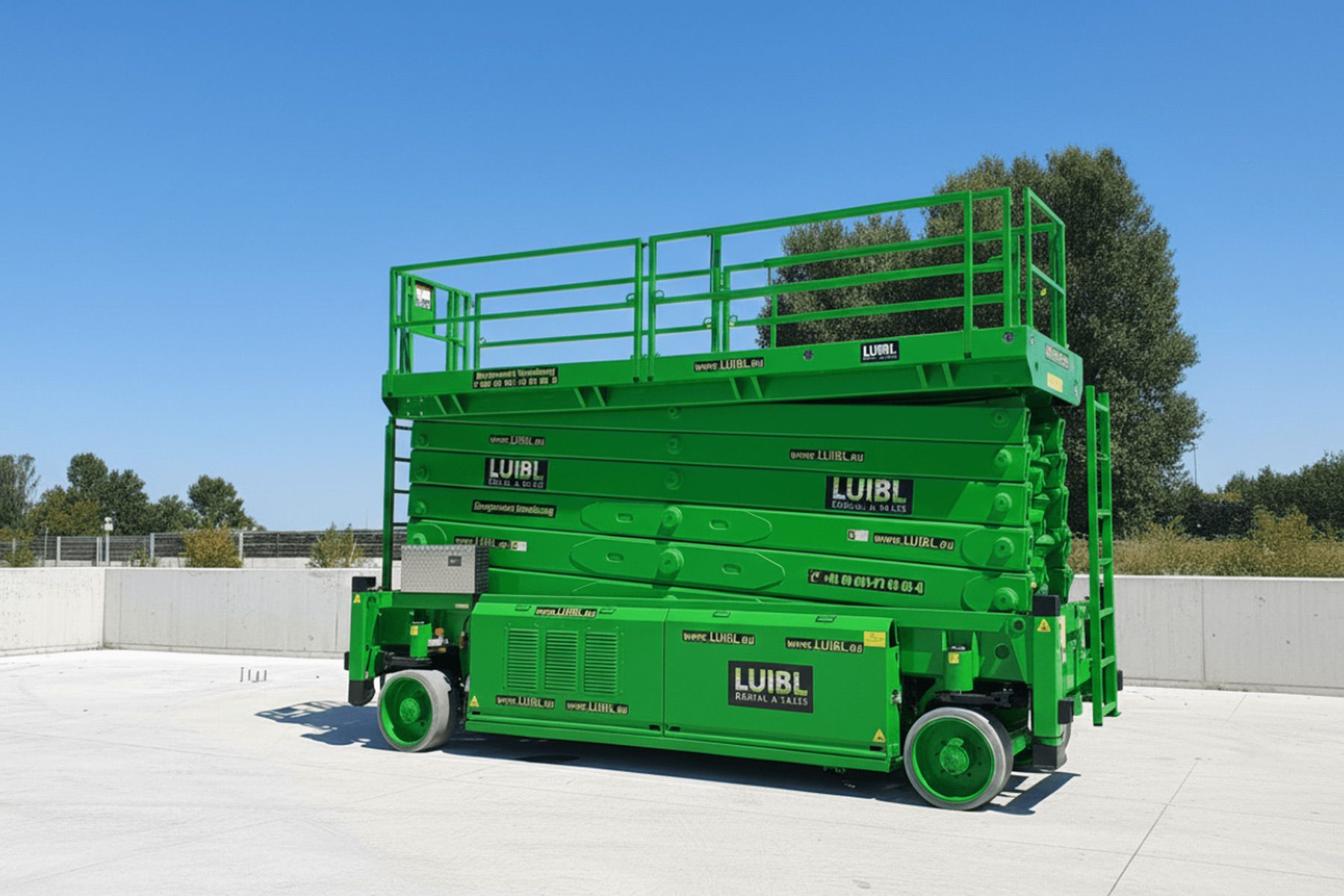
Scaffolding accompanies every larger construction project - from facade renovation and new builds to industrial installation. Yet the fixed facade scaffold has long ceased to be the only option for working safely at height. Over the past two decades, aerial work platforms, telescopic boom lifts and scissor lifts have become a genuine alternative: ready for use faster, more economical for short jobs and safer for spot work above obstacles.
This guide explains the system behind modern scaffolding, shows which jobs still belong to the classic scaffold - and where an aerial work platform is technically and economically superior. Luibl Rental & Sales specialises in access technology and delivers aerial work platforms throughout Belgium that replace or usefully complement scaffolding on many jobs.
Scaffolding - definition and scope
Scaffolding is the professional erection of temporary working and protective structures that give people safe access to workplaces at height. A scaffold is a fixed, modular structure made of frames, decks, guardrails, diagonals and anchors. It is planned for each project, erected, approved by a competent person and dismantled once the work is complete.
According to the common system of standards, scaffolding comprises three main functional categories:
- Working scaffolds serve as a platform for construction, installation and maintenance work
- Protective scaffolds protect people and structures against falls or falling parts
- Support scaffolds carry loads from formwork or load-bearing structures during the construction phase
The use of aerial work platforms must be distinguished from classic scaffolding. Aerial work platforms are motorised, mobile machines that lift people and materials to the workplace and hold them there. Legally, they are not scaffolds but work equipment within the meaning of the Code on Well-being at Work, Book IV (work equipment). This has far-reaching consequences for planning, staff qualification and operating costs - we return to this in section 7.
Types of scaffolding - the complete overview
Facade scaffold (frame scaffold)
The facade scaffold is the standard system in European construction. It consists of prefabricated frames anchored to the facade and connected by decks. Typical manufacturers are Layher, Plettac, Huennebeck, Rux and Altrex. Applications: plastering and painting, external wall insulation (ETICS), roofing, facade renovation. Erection and dismantling require trained scaffolders.
Modular scaffold (system scaffold)
Modular scaffolds such as Layher Allround or Plettac Perfect consist of vertical standards with connection nodes at regular intervals. Ledgers and diagonals can be connected at any angle. This makes it possible to follow complex geometries - church towers, stairwells, industrial plants, bridges.
Mobile scaffold tower (mobile working platform)
Mobile scaffold towers to NBN EN 1004-1 are single-bay, mobile aluminium structures with castors. They are used indoors up to a maximum platform height of 12 m and outdoors up to a maximum of 8 m. They are assembled by competent, instructed persons - no scaffolder is required. Use: interior fit-out, small ceiling renovations, painting.
Catch scaffold
A catch scaffold is a protective scaffold that prevents falls during work on pitched roofs. The top deck level is no more than 1.50 m below the eaves; the catch platform stops falling persons. When it is required is determined by the rules on work at height under the Code on Well-being at Work.
Birdcage scaffold and support scaffold
Birdcage scaffolds are erected across the full floor area indoors - typically for ceiling renovations in halls, churches or stations. Support scaffolds to NBN EN 12812 carry temporary loads, such as concrete formwork in bridge construction.
Suspended scaffold and cantilever scaffold
Suspended scaffolds are lowered from above, for example under bridges. Cantilever scaffolds project from one side of the structure when erection from the ground is not possible - for example above water or traffic routes.
Chassis without scaffold function: aerial work platforms as an alternative
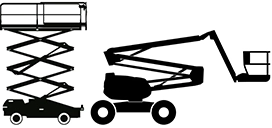
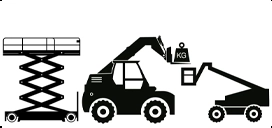
Alongside these classic scaffold types, the aerial work platform has established itself as a full alternative for all work where the workplace is localised or changing. Four main types cover virtually every job:
- Scissor lifts - vertical lift, platforms up to 34 m working height, load capacity up to 1,000 kg
- Telescopic and articulating boom lifts - outreach and work above obstacles, up to 58 m working height
- Spider lifts - off-road capable with gradeability of more than 50 %
- Truck-mounted platforms - quick change of location, no set-up time on site
For many projects where a scaffold used to be ordered by reflex, an aerial work platform is today the more economical, faster and often safer solution.
Technical comparison - scaffold vs. aerial work platform
The following table compares the key figures. The reference is typical values for facade scaffolds and mid-range aerial work platforms.
| Criterion | Facade scaffold | Mobile scaffold tower | Aerial work platform |
|---|---|---|---|
| Typical working height | up to 24 m (higher with stability calculation) | indoors 12 m / outdoors 8 m | scissor lifts up to 34 m, articulating up to 58 m |
| Outreach | 0 (tied to the facade) | 0 | up to 41 m (articulating) |
| Set-up time on site | 1-5 days depending on area | 30-90 minutes | 5-15 minutes (positioning, outriggers) |
| Required qualification | scaffolder, competent person | competent person | operator instruction (IPAF) |
| Working position | fixed platform | fixed platform, movable | freely positionable in 3D |
| Inspection | mandatory after erection | mandatory after erection | periodic inspection by an EDTC/SECT |
| Economical from | duration > 3 weeks | duration > 1 week | duration from a few hours to several weeks |
Key message: The shorter the job, the greater the outreach and the more demanding the terrain, the more clearly the balance shifts in favour of the aerial work platform.
Applications - when a scaffold, when an aerial work platform?
Clear scaffold jobs
A scaffold is indispensable when work is carried out over a long period across a large facade area. Specifically:
- Facade renovation over several weeks or months
- Installing external wall insulation (ETICS)
- Roofing and lead work at the eaves
- Plastering and stucco work with a lot of material stored on the working level
Here the scaffold provides a continuous working platform on which material can be stored, cut and processed. An aerial work platform would be economically inferior for these jobs because the time on site drives up the hourly rates.
Clear aerial work platform jobs
For the following work, the aerial work platform is technically and economically superior to the scaffold:
- Spot maintenance work - individual lights, cameras, air conditioning units, gutters
- Industrial installation - hall lighting, fire protection systems, ventilation, sprinkler systems
- Tree care and green space work - crown work is hardly possible with a scaffold
- Facade cleaning - glass surfaces, solar installations, billboards
- Work above obstacles - above roofs, installations, water, traffic routes
- Installation in logistics centres - work above racking that scaffolds cannot reach
- Short jobs under 2 weeks - where erecting and dismantling the scaffold takes longer than the actual work
The Manitou 160 ATJ (articulating boom lift with 16 m working height) or the Magni RTH 6.39 (roto telehandler with basket up to 39 m) cover work that would be either disproportionately expensive or simply impossible with a scaffold.
Hybrid jobs
Many projects benefit from a combination. Example of a car plant: for ongoing maintenance of production equipment the hall is not scaffolded - instead, scissor lifts for high-bay warehouses with heights of 22 m, 28 m and 33 m are used. On the facade, however, the scaffold remains the basis, supplemented by a truck-mounted platform for hard-to-reach areas.
Selection criteria for work at height
The choice between scaffold and aerial work platform follows a robust decision logic. In practice, six questions settle more than 90 % of all cases:
1. How long does the job last? Less than 2 weeks: aerial work platform. More than 4 weeks of work across a large area: scaffold. In between: do the maths.
2. How many metres of outreach are needed? Zero outreach and work directly on the facade: scaffold. Any other situation: consider an aerial work platform.
3. How many people work at height at the same time? More than two people with material: scaffold. One to two people with tools: an aerial work platform is sufficient.
4. What material has to be stored on the working level? Nothing to light tools: aerial work platform. Pallets, insulation boards, mortar: scaffold.
5. What is the ground like? Paved and level: all options. Rough or steep: spider lift (gradeability of more than 50 %).
6. Do obstacles have to be bridged? Yes (roofs, extensions, installations): articulating boom lift. No: scaffold or scissor lift.
A simple rule of thumb for the construction trade: anyone considering a switch from scaffold to aerial work platform for the first time usually starts with short maintenance jobs. The hourly cost of an aerial work platform is higher than the daily cost of a scaffold - but there is no set-up time, and work can start shortly after delivery.
Safety and regulations
In Belgium, scaffolding and the use of aerial work platforms are governed by different but overlapping rules: well-being at work legislation and European standards.
Belgium
The key texts are the Act of 4 August 1996 on well-being at work and the Code on Well-being at Work, Book IV (work equipment), which also covers aerial work platforms. For scaffolds, NBN EN 12810 and 12811 (facade scaffolds) also apply, as do the rules on work at height under the Code on Well-being at Work.
People who erect scaffolds need an appropriate professional qualification. Once complete, the scaffold must be checked and released by a competent person. For aerial work platforms, applicable Belgian safety rules apply: operator instruction (often to the IPAF standard), a regular refresher of that instruction is recommended, and the machine undergoes periodic inspection by an external technical inspection body (EDTC/SECT).
European standards
Aerial work platforms are also subject to the European standard EN 280 and CE marking. Periodic inspection is carried out in line with applicable Belgian safety rules; the operator briefing takes place on handover of the machine.
Inspection duties at a glance
- Scaffold: inspection after erection, daily visual check, re-inspection after any significant change
- Mobile scaffold tower: erection by an instructed person, release by a competent person
- Aerial work platform: periodic inspection by an external technical inspection body (EDTC/SECT) under the Code on Well-being at Work, Book IV, instruction on the specific machine
When you rent aerial work platforms from Luibl, you receive machines with a valid inspection report. For long-term rentals, periodic inspection is usually included at no extra charge.
Rent vs. buy - and the third option: buying in the service
The classic rent-or-buy decision looks slightly different for scaffolds than for aerial work platforms.
Renting or buying a scaffold
For private individuals and trade businesses with occasional scaffolding needs, renting through a scaffolding contractor is the norm - including erection, dismantling and structural approval. Buying a mobile scaffold tower pays off with recurring in-house demand, for example for painting companies.
Renting or buying an aerial work platform
Here the balance shifts clearly. New aerial work platforms quickly cost from 40,000 euros (scissor lift) to more than 350,000 euros (roto telehandler). Experience shows that the investment only pays for itself from 150-200 days of use per year. For most companies, renting is the economically superior option - especially with long-term terms from 3 months' rental.
The hybrid strategy
Many companies do best with a clear split: buying a single, frequently used scissor lift for core work and renting special machines (articulating boom lifts, roto telehandlers, scissor lifts for high-bay warehouses) per project. Luibl Rental acts here as a partner for special machines for end customers and other rental companies alike.
When you need neither your own scaffold nor your own platform
For individual projects with a clearly defined duration, a pure rental solution is the obvious choice. Luibl delivers throughout Belgium, by low-loader to your site. Periodic inspection, operator briefing on handover and, if required, on-site service are included in the package.
Conclusion and next steps
Scaffolding is no longer a monolithic topic. Anyone planning work at height today should consider two parallel worlds: the classic scaffold for extensive, longer facade work and the aerial work platform for localised, mobile, fast jobs. The distinction is technically clear and often economically surprising: in many cases the aerial work platform clearly beats the scaffold - even on projects where a scaffold was chosen by reflex.
Luibl Rental & Sales delivers aerial work platforms of all classes throughout Belgium - from compact electric scissor lifts for indoor use and spider lifts for rough terrain to roto telehandlers with 39 m basket height. One central contact handles aerial work platforms, telehandlers and forklifts alike - and takes care of delivery, periodic inspection, operator briefing on handover and, if required, on-site service.