Telehandlers in halls: choosing the right load capacity and clearance height
An industrial hall with 7.5 metres of clear height, 450 square metres of floor space and narrow storage aisles only 3.2 metres wide - and you regularly need to store 3.5-tonne components at a height of 5.2 metres. A standard counterbalance forklift does not fit, a mobile crane is oversized and too expensive. This is where the telehandler comes into its own in the hall.
Telehandlers (also called telescopic forklifts or telescopic handlers) are often the solution for indoor work when two conditions must be met: maximum vertical lifting power with minimum space requirement. Unlike conventional forklifts or scissor lifts, telehandlers combine the load capacity of a crane with the manoeuvrability of a forklift. But not every model fits every hall - and not every telehandler reaches the load capacity you need.
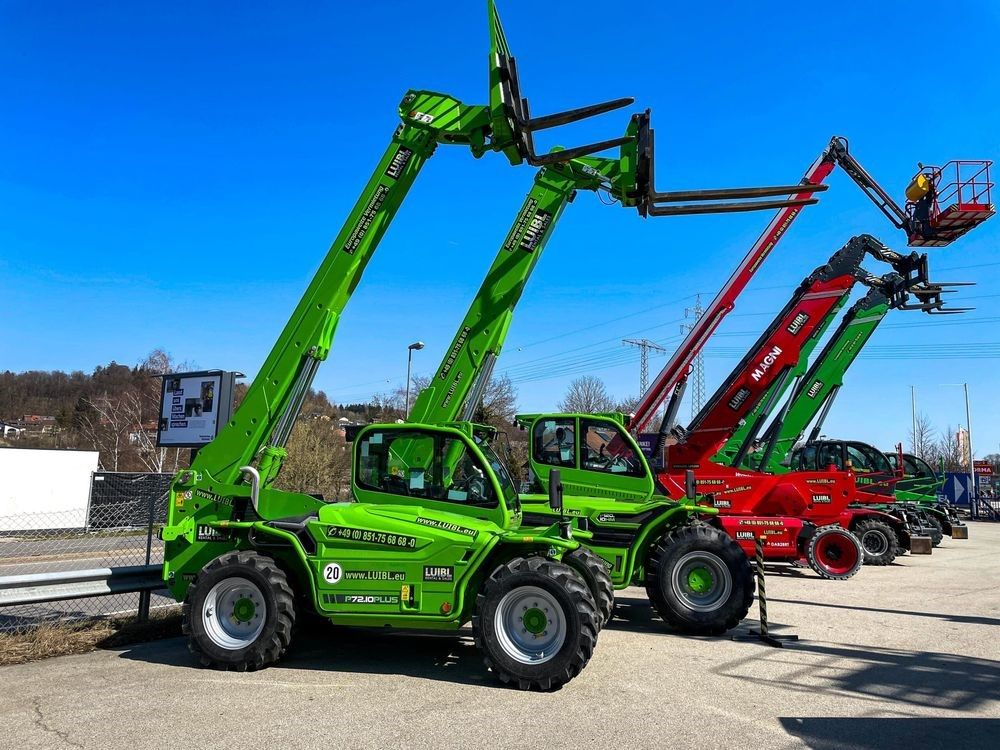
Luibl Rental offers a specialised range of telehandlers in a wide variety of load classes and designs. Whether fixed models for precise lifting and transport tasks or roto telehandlers for assembly work in industrial halls - we show you what matters.
The basics on designs, attachments and obligations are covered in the telehandler guide.
The two key questions for indoor use: clearance height and load capacity
Many users confuse two critical values: working height and clearance height. This leads to costly wrong decisions.
The clearance height is the maximum height of the machine itself when the telescopic boom is fully retracted. This is the figure that counts when you have to drive the telehandler through a hall door or under a canopy. A Manitou MT 625, one of the most compact fixed models in the Luibl fleet, has a clearance height of about 2.1 metres.
The working height (also called lift height), on the other hand, describes how high the load can actually be lifted when the boom is fully extended. The same Manitou MT 625 reaches a lift height of up to 6 metres - ideal when you need to store material at medium heights.
Practical example:
A warehouse manager in Ghent needed a telehandler for a storage hall with a clearance height of 2.5 metres (entrance doors). He initially chose a Merlo Roto 50.21, whose retracted height is 2.8 metres - not suitable. After consulting Luibl Rental, he rented a Manitou MT 930 H (clearance height 2.2 m) and still achieved 8.9 metres of lift height for his storage platform. The project ran without delay.
Understanding load capacity: dynamic reduction with outreach
The maximum load capacity - often stated on the rating plate or in the data sheet - applies under one single condition only: boom fully retracted in the stowed position. As soon as you extend the load by a few centimetres or lift it higher, the permissible load capacity drops according to a precise load chart.
This is not a defect but physics. The greater the horizontal distance (outreach) and the higher the load is lifted, the greater the tipping moment. The machine's load moment limiter (LMB) prevents you and your load from tipping forward uncontrollably.
Example: Magni RTH 5.21 S (roto telehandler)
-
At 0 m outreach, stowed position: 5 tonnes permitted
-
At 2 m outreach, 4 m height: ~2.8 tonnes permitted
-
At 5 m outreach, 15 m height: <1 tonne permitted
Ignoring this risks not only machine failures but also fines and, in the worst case, accidents. That is why Luibl Rental reviews the load chart together with the customer before every heavy-duty rental - especially when precise assembly work is involved.
Fixed vs. rotating telehandlers in the hall: the right choice
Fixed telehandlers (linear workers)
A fixed telehandler (e.g. Manitou MT 625, Merlo P 30.10 L) lifts and loads in one direction only: straight ahead. The telescopic boom has no slewing ring, and the load is always picked up in the direction of travel.
Advantages for indoor use:
-
More compact clearance heights (often under 2.3 m)
-
Higher residual load capacities (stability reserve) thanks to a fixed centre of gravity
-
Faster loading and unloading cycles when outreach is small
-
More economical for short-term rental
Application example:
A logistics company in Antwerp rented a fixed Merlo P 30.10 L for handling palletised goods (up to 3 tonnes) at a height of 4.5 metres. The work process was repetitive: pick up the pallet, raise, set down, return. The fixed telehandler was ideal - no slewing needed, maximum safety when unloading.
Roto telehandlers (3-in-1 machines)
A roto telehandler (e.g. Merlo Roto 50.21, Manitou MRT 2150, Magni RTH 5.21) has an endlessly rotating upper structure. The telescopic boom can rotate 360 degrees - the machine stands still while the load is positioned precisely.
Advantages for indoor use:
-
Central positioning: the machine stays in one place, the load is rotated by remote control and set down precisely
-
Universal attachments: with a work basket it becomes an aerial work platform, with a winch a compact crane
-
Huge time savings for assembly work (no repeated repositioning of the chassis)
-
Safe, controlled movements for sensitive components
Application example:
An automotive supplier in Leuven installed precision steel frames at positions in an 8.5 m high production hall. With a Magni RTH 6.30 roto, two workers were able to position the 4.2-tonne assembly centrally without moving the machine several times. The radio remote control enabled millimetre-precise placement. With a fixed telehandler, the project would have taken 30 % more time.
Hall construction and logistics centres: special machines for extreme conditions
In addition to standard telehandlers, Luibl Rental has two specialised categories for hall projects in its range:
High-rack telehandlers
For intralogistics and storage systems, there are specially developed telehandlers with extreme height but a minimal footprint. These machines reach working heights of 22 m, 28 m or even 33 m - ideal for automated high-bay warehouses, logistics centres and factory halls with silo-like storage.
The special feature: these machines have an extremely narrow chassis (often less than 1.8 m) to fit into narrow storage aisles. Conventional scissor lifts, articulating boom lifts or mast lifts are often too wide for this purpose.
Use case:
A logistics centre near Brussels stored electronic components at a height of 27 metres. Standard aerial work platforms did not fit into the 2-metre aisles. With a high-rack telehandler from Luibl, staff were able to reach full height safely while taking up only 1.6 metres of width.
Heavy-duty telehandlers for assembly tasks
When the issue in a hall is not space or load but space AND load, heavy-duty telehandlers come into play. The Manitou MHT 10200, a real rarity on the rental market, lifts up to 20 tonnes and is still more manoeuvrable than a mobile crane.
These machines are indispensable for:
-
Heavy machinery installation in production halls
-
Steel construction and shipbuilding (assembly of frames, blocks, structures)
-
Wind energy installations (storage and positioning of components)
-
Industrial park projects (central machine positioning without external crane logistics)
Case study:
An engine manufacturer in Wallonia had to set down 18-tonne blocks precisely on assembly platforms in a production hall. A standard mobile crane would have cost 450 € per day and required external delivery. Luibl provided a Manitou MHT 10200 for rent - flexible, ready for use and with integrated telescopic functions for precise handling.
Safety first: periodic inspection and qualification for indoor use
Telehandlers fall under Belgian well-being at work legislation and the Code on Well-being at Work, Book IV (work equipment), and call for the required operator qualification in line with applicable Belgian safety rules. For indoor use, too, this qualification is no minor matter.
In practice, the qualification is structured in three levels:
Level 1: basic training for fixed telehandlers
Needed for use as a forklift in conventional warehouse or site operations. Covers operation, safety procedures, load handling.
Level 2a: additional qualification for roto telehandlers and crane work
Needed when the machine is to carry a winch or load hook. Rotation changes the safety dynamics considerably - centrifugal forces, outreach and shifts in the centre of gravity must be understood.
Level 2b: aerial work platform with personnel basket
If you want to use a roto telehandler as an aerial work platform (work basket with up to 200 kg payload for two people). This is a separate qualification with higher requirements for stability, rescue and emergency procedures.
Luibl Rental provides an operator briefing on handover at your site. This is particularly useful for hall projects with several operators - staff learn the specific features of your hall (narrow aisles, roof loads, floor conditions) and the associated risks directly on the job.
In addition, every rental machine has an up-to-date periodic inspection by an external technical inspection body (EDTC/SECT). For long-term rentals, Luibl Rental takes care of the regular maintenance cycles and inspections - you have one contact who ensures compliance.
People, machines, moments: three case studies
Case 1: storage hall in Antwerp - conversion at short notice
Problem: A logistics service provider had to convert its storage hall from conventional floor pallet storage to high-rack storage in just 3 weeks. New racks up to 8.5 m high, and the old machines did not fit.
Solution: Luibl Rental provided three Merlo Roto 50.30. The roto telehandlers were manoeuvrable enough for the 2.8 m aisles and strong enough for 5-tonne pallets at full height. With radio remote control, the warehouse staff were able to work precisely.
Result: Conversion completed in 19 days. Cost saving compared with an external crane service: 12,000 €.
Case 2: steel structure assembly in Ghent - precision work
Problem: A steel construction company had to set down U-shaped steel frames (8.2 tonnes each) on foundation bolts in a production hall with centimetre precision. Tolerance: 5 cm in all directions.
Solution: Magni RTH 6.30 with radio remote control. The 360-degree rotation allowed the banksman to guide the load precisely from a central position. No repeated repositioning of the machine was needed.
Result: Assembly times 25 % shorter than with a conventional tandem set-up of forklift + aerial work platform. No damage, 100 % success rate when setting down.
Case 3: pharmaceutical logistics in Liege - hygiene and tight spaces
Problem: A pharmaceutical manufacturer needed a telehandler for an air-conditioned storage hall (constant 18 degrees C, 45 % humidity). The hall was only 1.9 m wide and 7.2 m high. In addition: non-marking tyres required (no soot on the sterile floor).
Solution: Electric telehandler Manitou MT 625e with non-marking tyres. Clearance height 1.95 m (just fits), no local emissions (no exhaust fumes in the closed hall), lift height 6 m.
Result: Daily operation over 8 weeks without faults. In addition: on handover on site, Luibl briefed 4 operators on safety with electric drive and the specific handling of the battery.
Measuring your hall correctly: the checklist before renting
Before you request a telehandler, measure your hall and note down these parameters:
-
Clearance height to the lowest obstacle (door frame, canopy, roof beams)
-> This is your maximum clearance height for travelling unladen -
Net clear height (floor to the underside of the roof structure or sprinkler system)
-> This determines the possible lift height under load -
Aisle width at the narrowest point
-> Minimum: chassis width + 20 cm safety margin -
Load weight and geometry (length x width x height)
-> Determines the required load capacity and outreach -
Floor conditions (asphalt, concrete, epoxy, specially treated)
-> If necessary, non-marking tyres, oscillating axle for uneven floors -
Frequency of use (daily, weekly, occasional)
-> Long-term rental or short-term rental -
Accessories required (winch, work basket, bucket, grab)
-> Not all attachments fit all machines
With this information, Luibl Rental prepares a tailor-made quote - no surprises on delivery.
FAQ: frequently asked questions about telehandlers in halls
- Can I use a roto telehandler in my hall with a height of 7 metres?
Yes, but with restrictions. A Merlo Roto 50.21 lifts up to 21 metres, but in your 7-metre hall you can only work up to the clear height (minus a safety distance, e.g. 6.5 m). More importantly: measure the clearance height of your entrance doors - it must be greater than the retracted height of the machine (~2.2-2.8 m for standard roto telehandlers).
- I need 4 tonnes of load capacity at a height of 5 metres and 3 metres of outreach. Which telehandler is suitable?
This is the classic 'load chart question'. A simple look at the rating plate does not help - you need the data sheet. The Magni RTH 5.21 S with a base load capacity of 5 tonnes only achieves this combination with 2-2.5 tonnes of actual load. A fixed Manitou MT 930 (16 tonnes base load capacity) would have significantly more residual capacity. Luibl Rental can calculate this for you in advance - free of charge.
- May I drive a rented telehandler without a periodic inspection?
No. This is not only a compliance problem but also a case where insurance does not cover you. Every Luibl telehandler is delivered with an up-to-date periodic inspection by an external technical inspection body (EDTC/SECT) (details in the inspection certificate). Your drivers need the required operator qualification in line with applicable Belgian safety rules. On handover, Luibl provides an operator briefing on the machine.
- How long does it take to deliver a telehandler to my hall?
Luibl Rental operates its own low-loader fleet and delivers throughout Belgium. Delivery usually takes place at short notice after receipt of the request. For critical projects, a lead time of 1-2 weeks is recommended (transport permits, final planning).
- Can I use a telehandler with a work basket as an aerial work platform in my 6-metre hall?
In theory yes, in practice with restrictions. The work basket for two people is itself 0.6 metres high. The maximum working height for people would therefore be 5.4 metres. In addition: you need an additional qualification (level 2b), and as lifting equipment for people the machine must have a periodic inspection by an external technical inspection body (EDTC/SECT). Luibl Rental checks this with you before the rental.
- Rotating or fixed - which telehandler is better for the storage hall?
It depends on the usage profile:
-
Fixed: repetitive handling at a single point (always the same position), higher residual load capacity, cheaper to rent
-
Roto: flexible positions, assembly work, use as a crane or aerial work platform, central positioning without travelling
- How much does it cost to rent a telehandler per day?
That is like asking 'How much does a car cost?'. Compact models (Manitou MT 625) start from approx. 180 € per day. Standard roto telehandlers (Merlo Roto 50.21) cost 220-280 € per day. Heavy-duty machines (Manitou MHT 10200) are in the 400-600 €/day range. Long-term rental (>4 weeks) allows significant discounts. Luibl Rental offers transparent quotes - no hidden small print.
- Do I need an operating permit to use a telehandler in my hall?
In a private storage hall: no. The telehandler is work equipment like a forklift - you only need the driver's qualification and the periodic inspection. In certain industries (e.g. chemicals, pharmaceuticals), additional safety regulations may apply. Clarify this with your site and with the Well-being at Work Inspectorate (FPS Employment).
Request now: tailored advice for your hall
You now know what matters with telehandlers in the hall: clearance height, load chart, the right machine type and safety.
But every hall is different. The best next step is a free consultation with a Luibl specialist. Bring the checklist above, share a photo of the hall and your requirements - and together we will prepare a quote that is guaranteed to fit.
Luibl Rental GmbH
Regensburger Strasse 61
94036 Passau
Contact: https://www.luibl.eu/kontakt/
Service hours: Mon-Fri, 08:00-17:00
Throughout Belgium. Flexible. Safe. That is Luibl Rental.