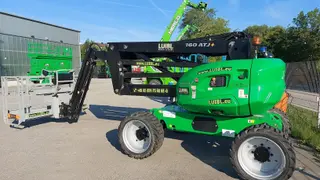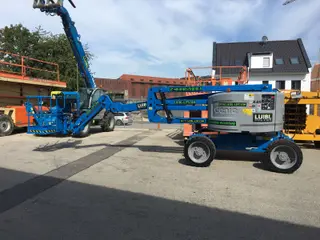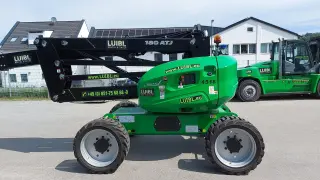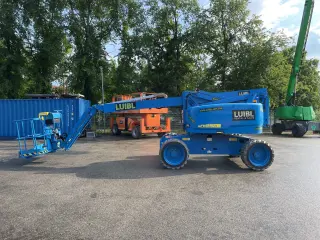
GTD-431 | Genie ZX 135/70
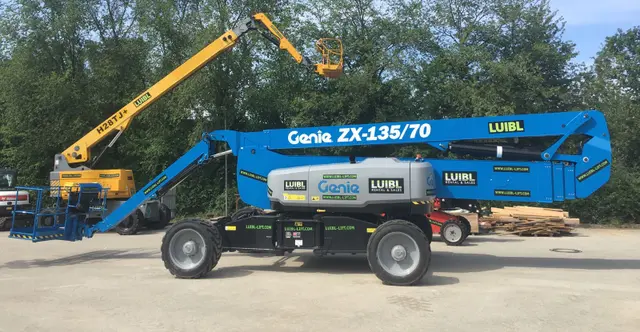
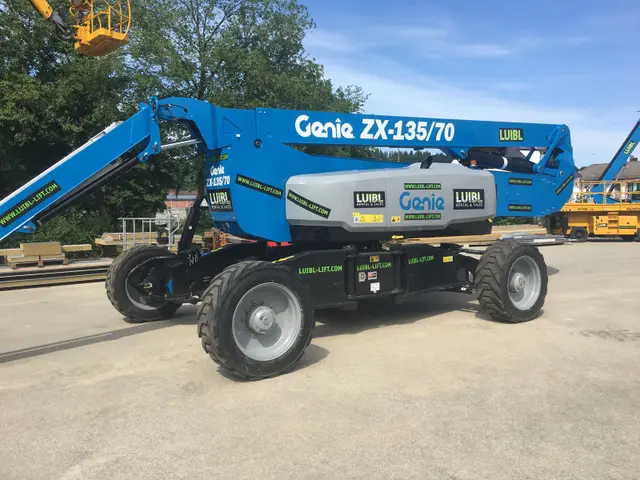
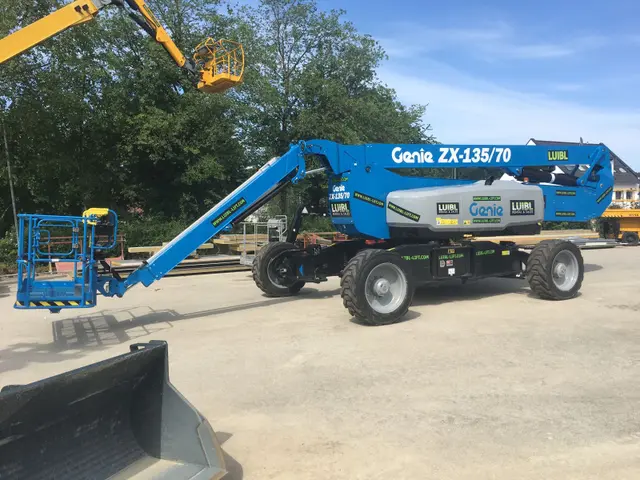
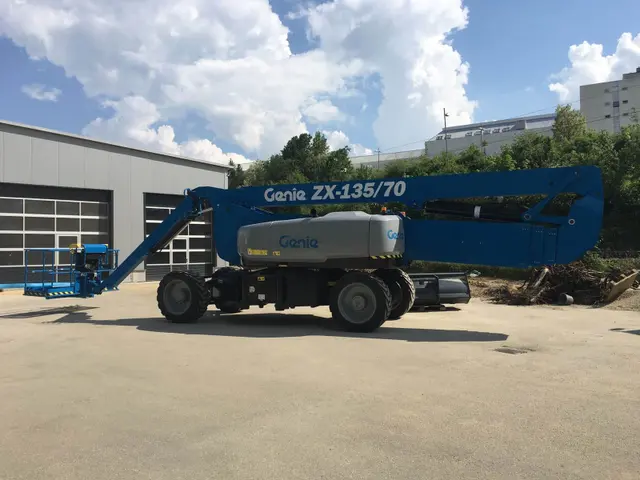
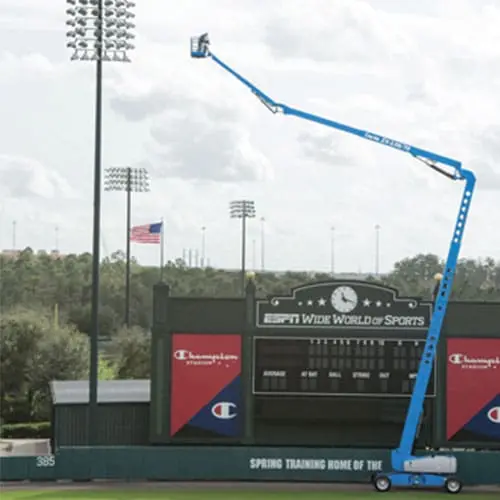
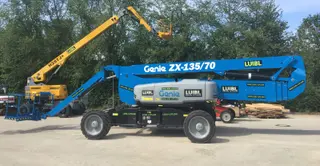
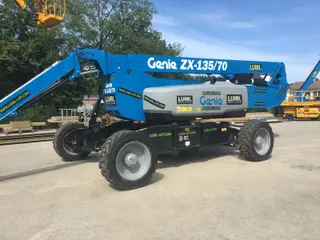
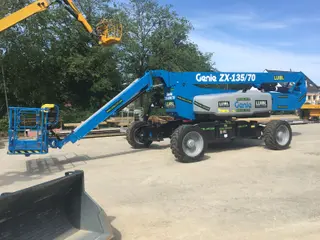
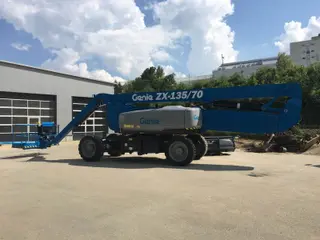
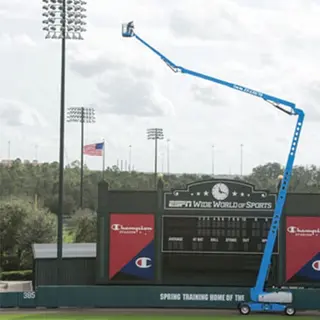
The Genie ZX-135/70 is not a machine for every job site. It is the answer to one specific question: how does a technician reach a point at 40 m height that lies 20 m horizontally from the set-up area – over an obstacle, without repositioning the platform? Anyone facing this problem will find the solution here. Anyone who is not is better served by a smaller machine. This article explains when renting the ZX-135/70 pays off, what is technically possible and what site managers should consider when making an enquiry.
Design of the ZX-135/70 diesel articulating telescopic boom lift
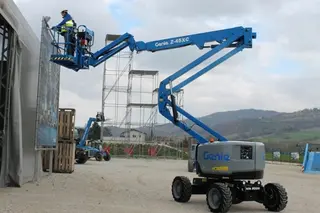
The ZX-135/70 combines three design features that set it apart from conventional telescopic boom lifts such as the Genie SX series: a full articulating boom with an additional riser, a telescoping jib (Jib-Extend) and an adjustable X-chassis. While a telescopic boom lift only extends in a straight line, the articulating geometry allows reaching over obstacles – roof overhangs, railings, pipelines, cooling towers.
In concrete terms: with the ZX-135/70, a working height of 43.15 m and a maximum horizontal outreach of 21.26 m result in a working envelope that a pure telescopic boom lift of this size cannot cover. The articulating boom can be angled without the machine having to be moved. In bridge inspection or in steel construction of hall structures, this is precisely the decisive advantage – every repositioning costs time and ties up personnel.
Maximum flexibility with the Jib-Extend system
The telescoping jib is the detail that really makes the ZX-135/70 stand out in practice. Instead of a rigid jib, the machine has a jib that extends from 3.66 m to 6.10 m – roughly 2.4 m of additional outreach exactly when the main boom position has already reached its limit. The vertical articulation range of the jib is 110°.
In practice this means: when the technician has to reach a point under an overhang, the main boom moves over the edge and the jib is lowered and extended. With fixed jibs without a telescoping function, the same working point often requires an additional machine repositioning – including securing the new set-up area, checking the load chart and setting up again.
Two platform options are available for the basket itself:
1.83 m steel platform with side-swing gate – the more compact version for confined access situations
2.44 m steel platform with three-sided entry and side-swing gate – more room to move for two technicians plus material
The platform capacity is 272 kg. That is sufficient for two people plus tools, but largely rules out heavy installation material such as steel plates or larger connecting elements. Anyone requiring higher platform loads should consider alternative heavy-duty models – in this discipline the ZX-135/70 is optimised for outreach, not for load.
Stability and manoeuvrability: the Mini Genie X-chassis
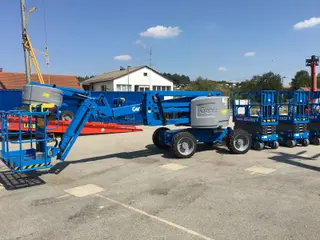
A machine with 43 m working height needs a correspondingly large footprint. The Genie X-chassis resolves the conflict between stability in operation and transportability through variable axle width. In operation, the axles extend and the machine obtains its maximum track width. For transport, the axles are retracted again and the unit fits on a standard low-loader.
The advantage becomes apparent with tight site access roads. Where a machine with fixed axle width gets stuck at a 2.55 m bottleneck, the ZX-135/70 passes through with its X-chassis retracted. On site it is then extended – the process takes a few minutes and is part of the standard set-up work.
The turntable rotates continuously through 360°. There is no end stop that forces turning back during complex positioning manoeuvres. For inspection runs along a facade or bridge, this allows continuous work without interruption.
Off-road capability and four-wheel drive
On the job site, three points decide whether a platform is truly ready for use – drive, steering, axle behaviour. The ZX-135/70 relies on:
Permanent four-wheel drive – the engine power is distributed to all four wheels. On gravel, soft ground or in wet conditions, this is the prerequisite for driving the machine safely into position at all.
Four steering modes – front-axle steering for normal travel, rear-axle steering for a tight turning circle, crab steering for sideways movement without cornering, coordinated four-wheel steering for maximum manoeuvrability.
Active oscillating axle system – ground unevenness is compensated mechanically so that all four wheels remain in contact with the ground. Without this function, safe standing would not be possible on typical job site ground.
Gradeability up to 45% – this value applies to travel with the boom retracted. When working at height, the machine must be levelled via the X-chassis and the tilt sensor.
The tyres have an off-road tread. This would be unsuitable for purely indoor use – once again showing the clear design of the machine for outdoor applications.
Applications of the ZX-135/70 in industry and infrastructure
A machine of this class is rarely rented for short jobs. Typical fields of application:
Bridge inspection and maintenance – the combination of large horizontal outreach and Jib-Extend allows access to bridge undersides, piers and bearings without having to work underneath the bridge.
Steel and hall construction – when placing beams at 30 to 40 m height, up-and-over movements across already installed structures are often unavoidable. The ZX-135/70 saves repositioning.
Power plant and cooling tower maintenance – a classic application for "up-and-over" geometry. Components on curved structures are reached over projections.
Industrial chimneys and stacks – outreach above 40 m enables inspections far into the upper shaft area.
High facades and glass structures – where erecting scaffolding is not economical, for example for short assignments or difficult geometries, the ZX-135/70 provides the necessary height and mobility.
In all cases: the machine is an investment in outreach. If 28 m working height is enough, a more compact model such as the Magni DAB28RT is the better choice in terms of logistics and cost.
Logistics, transport and delivery areas
Transporting a ZX-135/70 is not trivial. The machine weighs around 20.5 tonnes and requires a suitable low-loader.
We arrange delivery and transport by agreement.
Service during the rental period: with large machines, the availability of a technical contact person is particularly relevant. Technicians can be provided on request for instruction or troubleshooting.
Long-term rental: for projects lasting several months – such as large construction sites with ongoing demand – long-term terms including inspection and annual maintenance are available.
On request, you will receive an introduction to the machine at handover. The machine is handed over serviced and inspected.
FAQ: frequently asked questions about renting the Genie ZX-135/70
What is the transport width of the Genie ZX-135/70?
With the Mini Genie X-chassis retracted, the transport width is 2.49 m. On site, the chassis is then extended for operation.How large is the articulation range of the Jib-Extend?
The vertical articulation range is 110°. The jib length itself telescopes from 3.66 m to 6.10 m. In addition, the turntable rotates endlessly through 360° without an end stop.Can the Genie ZX-135/70 work below ground level?
The machine offers below-grade reach and can position the basket below the set-up level – relevant for bridge undersides or work on slopes. The exact maximum below-grade reach depends on the specific boom position and the working point and should be clarified in advance on the basis of the site geometry.What platform load is permitted?
272 kg on the platform. This corresponds to two people with tools and light material. For higher requirements, it is advisable to consider alternative heavy-duty models.How many people may stand on the platform at the same time?
Up to two people, provided the total platform load of 272 kg is not exceeded.Which steering modes are available?
Front-axle steering, rear-axle steering, crab steering for sideways travel and coordinated four-wheel steering for a minimal turning circle.Request project advice
With a machine like the ZX-135/70, clarifying outreach, obstacle geometry and set-up area in advance determines whether the rental makes economic sense. A short description of the application – working height, horizontal reach-over, set-up situation – is usually enough for an initial assessment.
Check availability now and request a quote.